Please Note: “The Laramie Project” will now be performed on March 28th at 7:30 p.m. and March 29th at 2:00 p.m.

Please Note: “The Laramie Project” will now be performed on March 28th at 7:30 p.m. and March 29th at 2:00 p.m.
AUDITIONS FOR “FAIRY TALES WITH A TWIST” COMING UP ON SUNDAY, AUGUST 24TH AT 6:00 P.M., JOHNSON HALL OPERA Johnson Hall Opera House IN GARDINER. PARTS AVAILABLE FOR 10-12 ACTORS, AGES 7-14 WHO ARE FLUENT READERS. COME HAVE SOME FUN…THE STORIES INCLUDE THE FOLLOWING:
“Fairy Tale Characters Sue The Storytellers”
“The Big Bad Pig and the Three Little Wolves”
“Little Red Hen Gets Really Ticked Off At All Her Friends”
“The Town Mouse and the Country Mouse Meet the Southern California Mouse”
“Three Blind Mice Get Even”
“The Tortoise and the Hare”
“Aladdin and the Magic Pickle Jar”

AUDITION NOTICE: Open Book Players will hold auditions for the children’s show, “Fairy Tales With A Twist” on Sunday, August 24th at 6:00 p.m., Johnson Hall Opera House in Gardiner.
Performances will be on September 27th at 7:00 p.m. and September 28th at 2:00 p.m. A rehearsal schedule will be available at the time of auditions.
Actors between the ages of 7 and 14 are invited but they must be fluent readers and there are parts for 10-12 actors. If you have any questions, feel free to private message me…help us to spread the word! Lucy Rioux, Artistic Director
AUDITION NOTICE: Open Book Players will hold auditions for the children’s show, “Fairy Tales With A Twist” on Sunday, August 24th at 6:00 p.m., Johnson Hall Opera House in Gardiner.
Performances will be on September 27th at 7:00 p.m. and September 28th at 2:00 p.m. A rehearsal schedule will be available at the time of auditions.
Actors between the ages of 7 and 14 are invited but they must be fluent readers and there are parts for 10-12 actors. If you have any questions, feel free to email me…help us to spread the word! Lucy Rioux, Artistic Director (lucyrioux@gmail.com)
PLEASE NOTE: Auditions for “Fairy Tales With A Twist” will actually be held on AUGUST 24TH at 6:00 p.m. and NOT August 31st! More information will be posted soon!! Johnson Hall Opera House, Gardiner, ME.
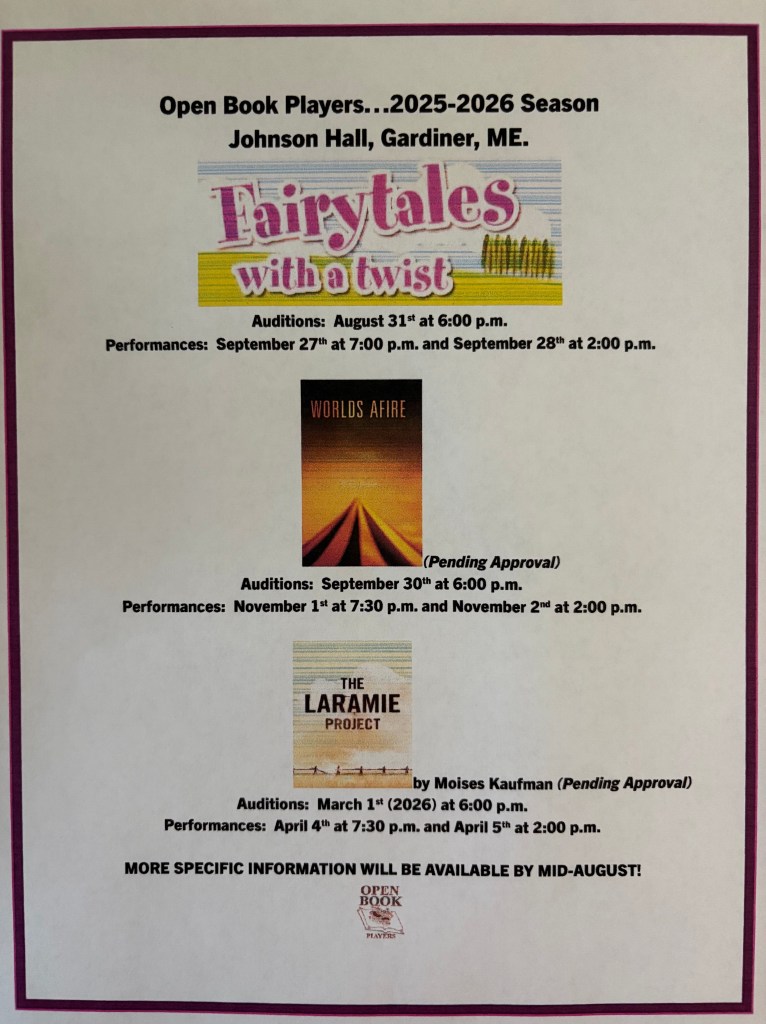
As promised…here is our 2025-2026 season productions to celebrate our 30th year!!
PART FIVE: Using Readers Theatre for “Teaching” and for “Social Services”…
Teaching: RT has a set of techniques and approaches that can be used to teach on all educational levels any subject matter that is converted into a proper script. Reading, grammar, literature, history, foreign language, science, mathematics, even workshop and other seemingly unlikely subjects, have been taught successfully through RT. Here is a list of examples and grade level suggestions:
Multiplication Script (K-2)
The Great Punctuation Olympics Practice (2-5)
Circles on the Earth (6-8)
Ellis Island (6-8)
Paul Revere’s Ride (6-8)
Martha Graham–A Biography (9-12)
Vincent Van Gogh (9-12)
There Will Come Soft Rains by Ray Bradbury (9-12)
Social Services: RT is being used for recreation at home, and as an entertainment for organizations, cruises, retreats, and other public entities; for the promotion of various social, political, religious and other causes; and as a therapeutically helpful activity for retirement homes, correctional facilities, high-stress professions, and many other areas where presentational theatre can make its unique contribution to special group needs. Here is a list of examples:
Where Is My Nana? (dealing with dementia/Alzheimer’s)
Hungry (dealing with eating disorders)
Bloodborne Pathogens (educational training presentation)
Sexual Harassment Script
Just about any piece of writing/literature can be scripted using Readers Theatre techniques, but remember if you plan any “public” performance of any work that is not original or in the public domain, you will need to get permission from the author and/or publisher. Use in the classroom for educational purposes is usually “safe” but it is always best to check.
This will conclude our “Introduction to Readers Theatre Styles and Technique”, but if you have any questions or would like to receive a copy of the above mentioned RT scripts, private message me and we can go from there.
COMING SOON…Open Book Players 30th Season List of Productions! Hopefully by July 1st!!!

Coming shortly, applications of Readers Theatre in education and social services. Look for this by June 9th!!
PART FOUR: Staging For The Different Styles of Readers Theatre
The four major styles of Readers Theatre include the following:
1. Simple Readers Theatre…This is the least external style that formalizes the presentation of the script with an emphasis on interpretation of the text through inner responses of thought, emotion and experience with a minimum of physical activity.
2. Staged Readers Theatre…This is an intermediate style that has a formal setup, but externalizes the actions of the script with characters on revolving stools and narrators situated at music stands. This is the preferred style that Open Book Players uses in their readers theatre productions.
3. Chamber Theatre…The most active style that resembles conventional theatre by utilizing full-stage choreography, more elaborate elements of stage craft, and memorized lines. Unlike representational theatre, it retains the narrative text, and is much more suggestive than literal in performance and production.
4. Story Theatre…This is a type of theatre, also known as readers theatre, where actors present dramatic readings of narrative material without elaborate costumes, props, scenery, or lighting. The focus is on vocal expression and script to convey the story to the audience. The actors do their own narration along with the “character” lines.
A video demonstrating these four styles will be added within a couple of days…look for it!
Here is the video!!!
Our last post related to Readers Theatre instruction will be about “Offstage Focus” along with how Readers Theatre can be used beyond “Entertainment”.
Part Three…AN EXAMPLE OF SCRIPTMAKING
The technique used by Open Book Players when scripting a literary piece is one where the “characters” share the narration, therefore using “Narrators” assigned to each major character in the story. There are more complicated scripting techniques, but this style works well with most literary pieces. I have chosen an Aesop Fable to demonstrate how this can work. First, the fable:
The Town Mouse & the Country Mouse…an Aesop Fable
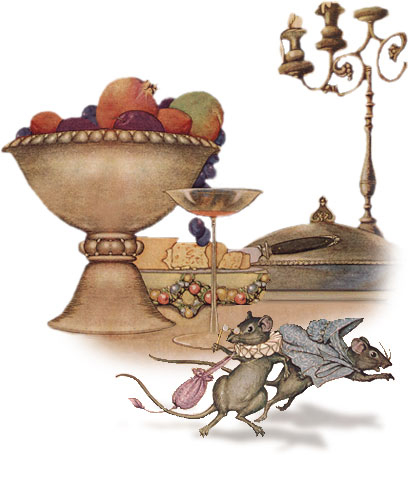
A Town Mouse once visited a relative who lived in the country. For lunch the Country Mouse served wheat stalks, roots, and acorns, with a dash of cold water for drink. The Town Mouse ate very sparingly, nibbling a little of this and a little of that, and by her manner making it very plain that she ate the simple food only to be polite.
After the meal the friends had a long talk, or rather the Town Mouse talked about her life in the city while the Country Mouse listened. They then went to bed in a cozy nest in the hedgerow and slept in quiet and comfort until morning. In her sleep the Country Mouse dreamed she was a Town Mouse with all the luxuries and delights of city life that her friend had described for her. So the next day when the Town Mouse asked the Country Mouse to go home with her to the city, she gladly said yes.
When they reached the mansion in which the Town Mouse lived, they found on the table in the dining room the leavings of a very fine banquet. There were sweetmeats and jellies, pastries, delicious cheeses, indeed, the most tempting foods that a Mouse can imagine. But just as the Country Mouse was about to nibble a dainty bit of pastry, she heard a Cat mew loudly and scratch at the door. In great fear the Mice scurried to a hiding place, where they lay quite still for a long time, hardly daring to breathe. When at last they ventured back to the feast, the door opened suddenly and in came the servants to clear the table, followed by the House Dog.
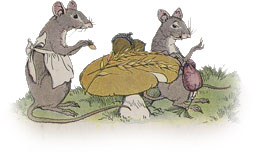
The Country Mouse stopped in the Town Mouse’s den only long enough to pick up her carpet bag and umbrella.
“You may have luxuries and dainties that I have not,” she said as she hurried away, “but I prefer my plain food and simple life in the country with the peace and security that go with it.”
Poverty with security is better than plenty in the midst of fear and uncertainty.
AND NOW THE SCRIPTED VERSION…Please note that not a word of the text has been changed and that the point of view has been totally preserved.
THE TOWN MOUSE AND THE COUNTRY MOUSE
By Aesop
Scripted for Readers Theatre by Lucy Rioux
Reader 1…Narrator for Town Mouse (N1)
Reader 2…Town Mouse (TM)
Reader 3…Country Mouse (CM)
Reader 4…Narrator for Country Mouse (N2)
TM & CM: The Town Mouse and the Country Mouse
N1 & N2: an Aesop Fable
N1: A Town Mouse once visited a relative
TM: who lived in the country.
N2: For lunch the Country Mouse served
CM: wheat stalks, roots, and acorns, with a dash of cold water for drink.
N1: The Town Mouse ate very sparingly,
TM: nibbling a little of this and a little of that,
N1: and by her manner making it very plain that she ate the simple food
TM: only to be polite.
N1 & N2: After the meal the friends had a long talk,
N1: or rather the Town Mouse talked about her life
TM: in the city
N2: while the Country Mouse
CM; listened.
Page 2
N1 & N2: They then went to bed
TM: in a cozy nest in the hedgerow
CM: and slept in quiet and comfort until morning.
N2: In her sleep the Country Mouse dreamed she was
CM: a Town Mouse with all the luxuries and delights of city life
N2: that her friend had described for her.
CM: So the next day
N1: when the Town Mouse asked the Country Mouse to go home with her
TM: to the city,
N2: she gladly said
CM: yes.
N1 & N2: When they reached the mansion in which the Town Mouse lived,
N1: they found on the table in the dining room
N2: the leavings of a very fine banquet.
CM: There were sweetmeats and jellies,
TM: pastries, delicious cheeses,
ALL: indeed,
CM: the most tempting foods that a Mouse can imagine.
N2: But just as the Country Mouse was about to nibble
Page 3
CM: a dainty bit of pastry,
N2: she heard a Cat mew loudly
CM: and scratch at the door.
CM & TM: In great fear
N1 & N2: the Mice scurried
CM & TM: to a hiding place,
N1 & N2: where they lay quite still for a long time
CM & TM: hardly daring to breathe.
N1 & N2: When at last they ventured back to the feast,
CM & TM: the door opened suddenly
TM: and in came the servants to clear the table,
ALL: followed by the House Dog.
N2: The Country Mouse stopped in the Town Mouse’s den only long enough
TM: to pick up her carpet bag and umbrella.
CM: “You may have luxuries and dainties that I have not,”
N2: she said as she hurried away,
CM: “but I prefer my plain food and simple life in the country with the peace and security that go with it.”
ALL: Poverty with security is better than plenty in the midst of fear and uncertainty.
THE NEXT POST WILL FOCUS ON STAGING OF DIFFERENT STYLES OF READERS THEATRE…hopefully posted by May 19th.